Location
Independence, MO
Addiction treatment in Independence
Living with substance dependence can make you feel like you’re no longer in control of your body or your mind. You may already know it’s hurting your health, your relationships, and your work, and still find that every attempt to cut back ends with cravings, irritability, or feeling low.
If you live in Independence, MO, Midtown Recovery Center offers outpatient addiction treatment at 1000 W 46th Street in Kansas City, MO, a short drive west of Independence. We treat substance use disorders and co-occurring mental health conditions, such as depression and anxiety.
Our programs include partial hospitalization (PHP), intensive outpatient (IOP) with day and evening tracks, outpatient care, and medication-assisted treatment with Suboxone, Sublocade, or Vivitrol. You live at home and can keep up with work, school, and family while you’re in treatment.
We work with all major commercial insurance companies, and same-day admission may be available once your insurance is verified and your assessment is complete.

Levels of care at this location
Every person starts treatment in a different place. That’s why Midtown offers four outpatient levels of care, all at our Kansas City, MO location. Your assessment helps decide which fits your needs, schedule, and recovery goals.
Partial Hospitalization Program (PHP)
PHP offers the most structure we provide. You attend treatment Monday to Saturday, from 9:00 am to 2:45 pm. The typical length is 4 to 6 weeks. Since you go home each day, you can start using new coping skills right away.
Intensive Outpatient Program (IOP)
IOP offers two tracks. The day track runs from 9:00 am to 12:00 pm. The evening track runs from 5:30 pm to 8:30 pm and works well if you have a job or classes. Typical length is 30 to 90 days.
Outpatient Program (OP)
Outpatient care is our most flexible level of care. It often fits people who have completed a higher level and want ongoing support. Your schedule and length of care are set with your treatment team.
Medication-Assisted Treatment (MAT)
MAT pairs medication with therapy. Midtown offers Suboxone, Sublocade, and Vivitrol. These medications can ease cravings, which gives you room to focus on therapy and build coping skills.
Detox and Residential Treatment
Midtown doesn’t provide medical detox, inpatient rehab, or residential treatment. If you need one of those first, our admissions team can refer you to a provider that offers it, and you can continue your care with us afterward.
What Happens When You Call
Calling for help takes courage. It also raises plenty of questions. Here’s what to expect, from the first call to your first day:
The call
Starting addiction treatment begins with one call. Admissions is available 24/7, so you can call at any hour, for yourself or for someone you love in Independence.
You don’t need to have it all figured out. A member of our team listens first, then asks about your situation, the substances involved, any mental health concerns, and your insurance. Everything you say is confidential and protected by federal privacy law for substance use treatment. Those answers help us point you toward the right level of care.
Most first calls are short. If you want to talk longer, you can, and if you just want to ask a question and think it over, that’s fine too.
Verification and same-day admission
Next, we verify your insurance. We work with all major commercial insurance companies. Benefits vary by plan, so we check what yours covers for each level of care and tell you where you stand before you commit to anything. You can also use the Verify Insurance button on this page.
Midtown does not accept Medicaid or Medicare. Payment plans are available, and we provide private-pay rates on request.
Same-day admission may be available once we verify your insurance and complete your assessment, so the sooner you call, the sooner both can start. When your first day is set, your admissions coordinator tells you exactly what to bring and where to go.
Intake: day one
Your first day starts with an assessment. Our team uses it to understand your substance use, your health history, and any mental health conditions, then matches you to the right level of care, such as PHP or IOP. If you’re living with depression, anxiety, or another condition alongside substance use, say so; it shapes your plan.
Midtown is an outpatient program, so you don’t stay overnight. You come to our building at 1000 W 46th Street in Kansas City, Missouri, attend your sessions, and go home to Independence at the end of the day. Your first day also covers the practical side: your schedule, what to expect in group, and who to contact with questions.
The facility
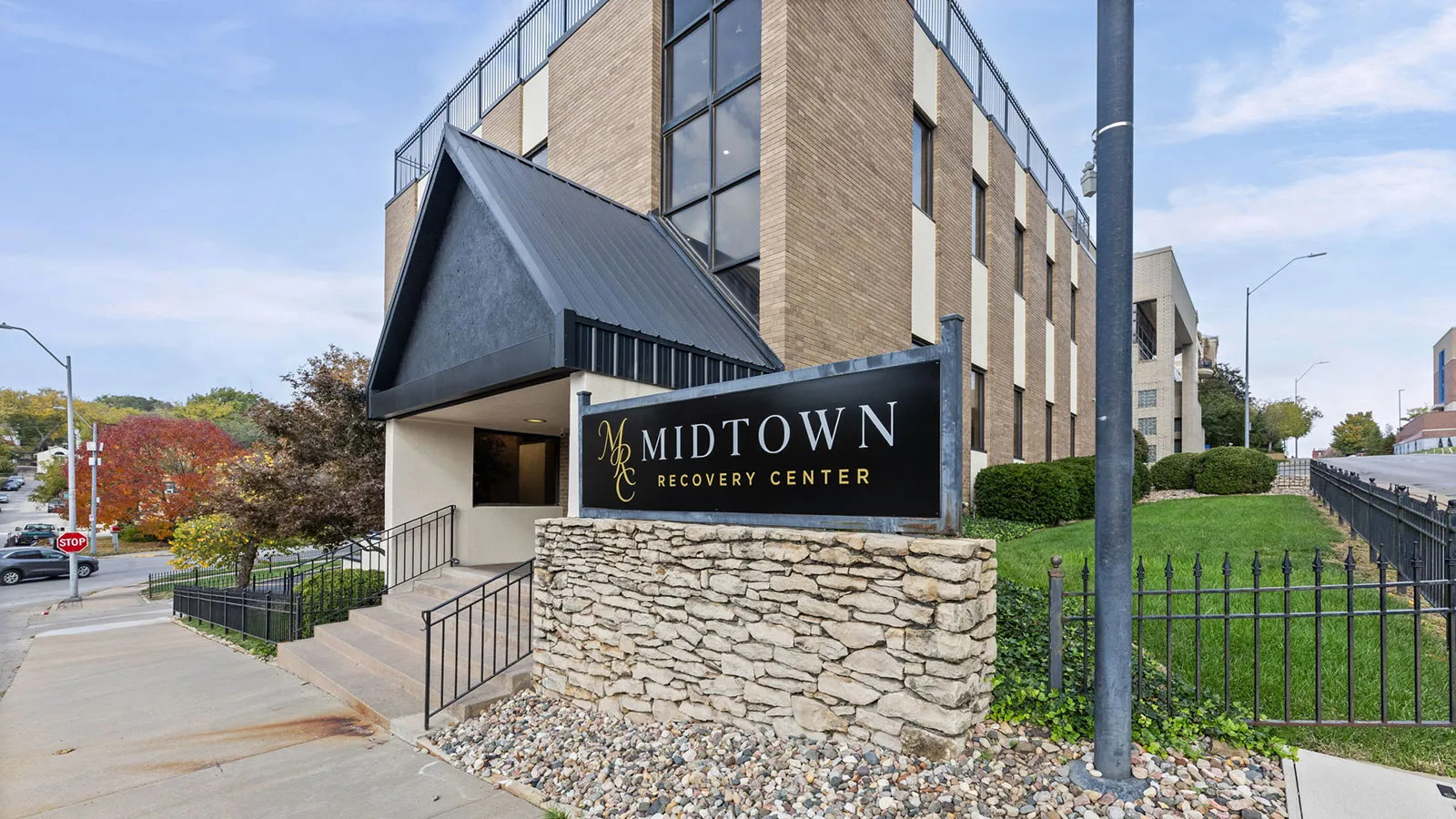
Midtown Recovery Center is located in a two-story standalone building at 1000 W 46th Street in Kansas City, Missouri. The space is designed to feel comfortable and upscale, because showing up for treatment is hard enough.
Here’s what you’ll find inside:
- Three group rooms for group sessions
- Private offices for individual conversations with our team
- A client lounge for time between sessions
Daily life and amenities
Because every program at Midtown is outpatient, daily life stays yours. You come in for your scheduled block, whether that’s a full PHP day, a three-hour IOP session, or an outpatient appointment, and the rest of the day is for work, family, and practicing what you learned.
While you’re here, the day moves between group rooms and private offices. The client lounge is yours between sessions for a coffee, a quiet moment, or a conversation with someone who understands. You don’t need to bring much; your admissions coordinator goes over the short list before your first day.
Privacy and discretion
Privacy matters when you’re seeking substance use treatment, and the law is on your side. Federal confidentiality rules for addiction treatment (42 CFR Part 2) and HIPAA protect your records and go further than ordinary medical privacy.
In practice, that means staff will not confirm to a caller that you are a client, or share anything about your care, unless you have signed a release naming that person. You decide who is in the loop, and you can change that at any time. Your employer only learns what you choose to tell them.
Getting here

Midtown is in Midtown Kansas City near Westport and the Country Club Plaza, roughly 20 to 30 minutes from Independence depending on traffic. Use the map on this page to see exactly where we are, and if you’d like help finding us, call admissions any time.
Directions and map
From Independence, most people take I-70 west toward downtown Kansas City, then US-71 (Bruce R. Watkins Drive) south or Southwest Trafficway toward Westport and 46th Street. US-24 and Truman Road are the usual surface-street routes. The building is a two-story standalone at 1000 W 46th Street in Kansas City, Missouri, a few blocks west of Main Street. Enter the address into your maps app for turn-by-turn directions, and ask admissions about arrival details when you schedule your first day.
Coming from out of area
Many of our clients come from across the Kansas City metro, including Independence, and some come from further away. Because Midtown is outpatient, you need somewhere to stay during treatment. If you don’t have a safe, substance-free place nearby, tell admissions. We have relationships with local sober living homes and can help you think through options before you start.
If you’re coming from out of state, your commercial insurance usually travels with you, though plan rules vary. We verify that with your insurer before you commit.
Therapies offered here

Therapy is where much of your recovery happens. Our therapy staff is credentialed in three approaches:
- Cognitive Behavioral Therapy (CBT): helps you spot thoughts that fuel substance use and replace them with healthier responses.
- Dialectical Behavior Therapy (DBT): builds coping skills for managing intense emotions, handling stress, and strengthening relationships.
- Eye Movement Desensitization and Reprocessing (EMDR): helps you process painful memories that may be tied to your substance use.
You work in both settings: individual sessions with a consistent clinician, and group sessions in our three group rooms where hearing from others who face similar struggles can help you feel less alone. Many people with addiction also live with depression, anxiety, bipolar disorder, or trauma, and these therapies treat both at the same time. How often you meet individually and in group follows your level of care and is set with your treatment team.
Addiction Treatment For Family
If you’re worried your parent, sibling, or spouse has a drinking or drug problem, encourage them to seek professional help but take care not to use a judgmental tone. Be honest and open about your concern and your desire to support them until they reach recovery.
You can also be part of their healing journey. At Midtown Recovery, family sessions can be held up to once a week, so family members can to offer moral support, learn healthy communication, and understand how to create a positive environment at home.
Getting a loved one here
Talking about substance use and treatment is hard, and when someone you love is struggling, you may feel helpless. These tips can show you where to start:
- Pick a calm, private moment when your loved one is sober.
- Lead with concern and share specific examples of what you’ve seen, without labels or blame.
- Offer to help with the call to admissions, and to drive them to their first day.
You can call together or call first on your own. We can walk you through the steps, including insurance verification, and if they refuse right now, keep the door open. Many people say yes on the second or third conversation.
Visiting, calls, and contact
Because Midtown is outpatient, there are no visiting hours to plan around. Your loved one comes home every day, and family involvement happens through family sessions rather than visits.
If you’d like updates on how treatment is going, your loved one can sign a release naming you. Without it, staff can’t confirm anything, including whether someone is a client. Phone use during program hours is covered at intake, and admissions can answer questions about contact any time.
Family programming
Family sessions are part of the program and can be held up to once a week. They’re led by your loved one’s clinical team and give the family a structured place to talk openly, understand how addiction and recovery work, and rebuild trust. Some time is spent together and some with family members on their own, so you can ask your questions freely.
After treatment, Midtown’s family group, part of our aftercare, offers continued support from other families who understand. Want to know how your family can take part? Call admissions, and we’ll explain how it works.
Aftercare

In aftercare and relapse prevention programs, patients receive continued care to ensure their sobriety and abstinence after graduating from treatment.
The Midtown Recovery Center, near Independence, Missouri, gives you access to an alumni group and family group as part of the aftercare track.
Plus, we have relationships with local sober living homes to help recovering addiction patients transition from supervised intensive treatment to an uncontrolled environment.
Addiction in Jackson County
Independence sits in Jackson County, Missouri, and recent data shows why local help matters:
- MIMH Addiction Science counted 402 drug-involved deaths across the four-county Kansas City area in 2024, a 10% decrease from the year before. Jackson County drives that regional trend.
- In Jackson County, deaths involving stimulants rose 4% in 2024, and deaths involving both stimulants and opioids rose 14%.
- Opioid-involved deaths in the county fell 4% and fentanyl-involved deaths fell 8%, yet fentanyl was present in 88% of opioid-involved deaths in the area during the first half of 2024.
- Jackson County COMBAT reports that emergency departments treated more than 1,200 local residents for overdoses in 2023, with opioids, methamphetamine, and cocaine among the most common drugs involved.
The drop in total deaths is encouraging, but 402 in one year is still far too many, and stimulants are part of the picture alongside opioids. Part of the response is timely treatment close to home. If you or someone you love in Independence needs help, call Midtown today.
FAQs
What types of substance use disorder are there?+−
Substance use disorders are grouped by the drug involved. The most common are alcohol use disorder; opioid use disorder, including fentanyl, heroin, and prescription painkillers such as oxycodone; cannabis use disorder; and stimulant use disorder, involving cocaine or methamphetamine. Others include sedative, hypnotic, or anxiolytic use disorder (prescription sedatives and sleep medications such as benzodiazepines), hallucinogen use disorder (LSD, PCP, or psilocybin), and nicotine use disorder.
What is the most common substance use disorder?+−
The most common SUD in the U.S. is alcohol use disorder, with 1 in 10 Americans over the age of 12 having AUD, according to NCDAS statistics. The same study shows that it’s one of the most prevalent SUDs worldwide as well, responsible for nearly 5% of annual deaths (2.6 million people).
What are the 4 C’s of addiction (substance use disorder)?+−
The four C's are compulsion, craving, loss of control, and consequences. Compulsion is a hard-to-resist drive to seek out and use a substance despite the damage it causes. Craving is a strong physical or psychological urge, close to hunger or thirst, that leaves a person restless when it isn't satisfied. Loss of control means being unable to cut back or stop despite genuinely wanting to. Consequences refers to continuing to use while fully aware of the harm to health, relationships, work, and finances.
What are the main components of an addiction treatment plan?+−
Most addiction treatment plans combine several parts, though details vary by provider. Many start with medical detox, a supervised period of withdrawal with medication to ease symptoms; Midtown doesn't provide detox, but our admissions team can refer you to a provider that does. From there, the core is behavioral therapy in individual and group sessions, using evidence-based approaches such as CBT and DBT. Medication-assisted treatment pairs FDA-approved medication with counseling when it fits, and dual diagnosis care treats any co-occurring mental health condition at the same time. Peer support and an aftercare and relapse prevention plan round it out and prepare people for life after the program.
We Accept Most Major Insurance Plans
Don't let cost be a barrier to recovery. Most treatment is covered by insurance.
Our Team
Medical Director
MD
Clinical Director
LCSW
Admissions Coordinator
Accredited & Licensed
Visit Us in Kansas City
Serving Independence, MO from our Kansas City facility.
1000 West 46th Street
Kansas City, MO 64112