Location
Missouri
Addiction Treatment in Missouri
If drugs or alcohol have started to take over your health, your work, or your relationships, you don’t have to keep trying to fix it on your own.
Midtown Recovery Center provides outpatient addiction treatment for people across Missouri at our facility at 1000 W 46th Street in Kansas City. We treat substance use disorders and co-occurring mental health conditions, such as depression and anxiety, for adults who want structured care while living at home.
Our programs include partial hospitalization (PHP), intensive outpatient (IOP) with day and evening tracks, outpatient care, and medication-assisted treatment (MAT). We work with all major commercial insurance companies, and admissions is available 24/7.

Levels of care at this location
Midtown offers four outpatient levels of care. Your assessment helps decide which one fits your needs, schedule, and recovery goals.
- Partial Hospitalization Program (PHP): Monday to Saturday, 9:00 am to 2:45 pm. Typical length is 4 to 6 weeks.
- Intensive Outpatient Program (IOP): a day track from 9:00 am to 12:00 pm and an evening track from 5:30 pm to 8:30 pm. Typical length is 30 to 90 days. The evening track works well if you have a job or classes.
- Outpatient Program (OP): our most flexible level of care, designed for ongoing support.
- Medication-Assisted Treatment (MAT): Suboxone, Sublocade, or Vivitrol, combined with therapy.
Midtown doesn’t provide medical detox or residential treatment. If you need either first, our admissions team can refer you to a provider that offers it, and you can continue your care with us afterward.
What happens when you arrive
Here’s what to expect once you decide to get help at Midtown Recovery Center:
The call
Admissions is available 24/7, so help is within reach whenever you’re ready to call. You can call for yourself or for someone you love.
Verification and same-day admission
We work with all major commercial insurance companies. Benefits vary by plan, so our admissions team checks what yours covers before you start. Midtown doesn’t accept Medicaid or Medicare.
Same-day admission may be available once your insurance is verified and your assessment is complete. Payment plans are available, and private-pay rates are provided on request.
Intake: day one
Your first day starts with an assessment. Our team uses it to understand your substance use, your health history, and any mental health conditions, then matches you to the right level of care, such as PHP or IOP. If you’re living with depression, anxiety, or another condition alongside substance use, say so; it shapes your plan.
Midtown is an outpatient program, so you don’t stay overnight. You come to our building at 1000 W 46th Street in Kansas City, Missouri, attend your sessions, and go home to your community at the end of the day. Your first day also covers the practical side: your schedule, what to expect in group, and who to contact with questions.
The facility
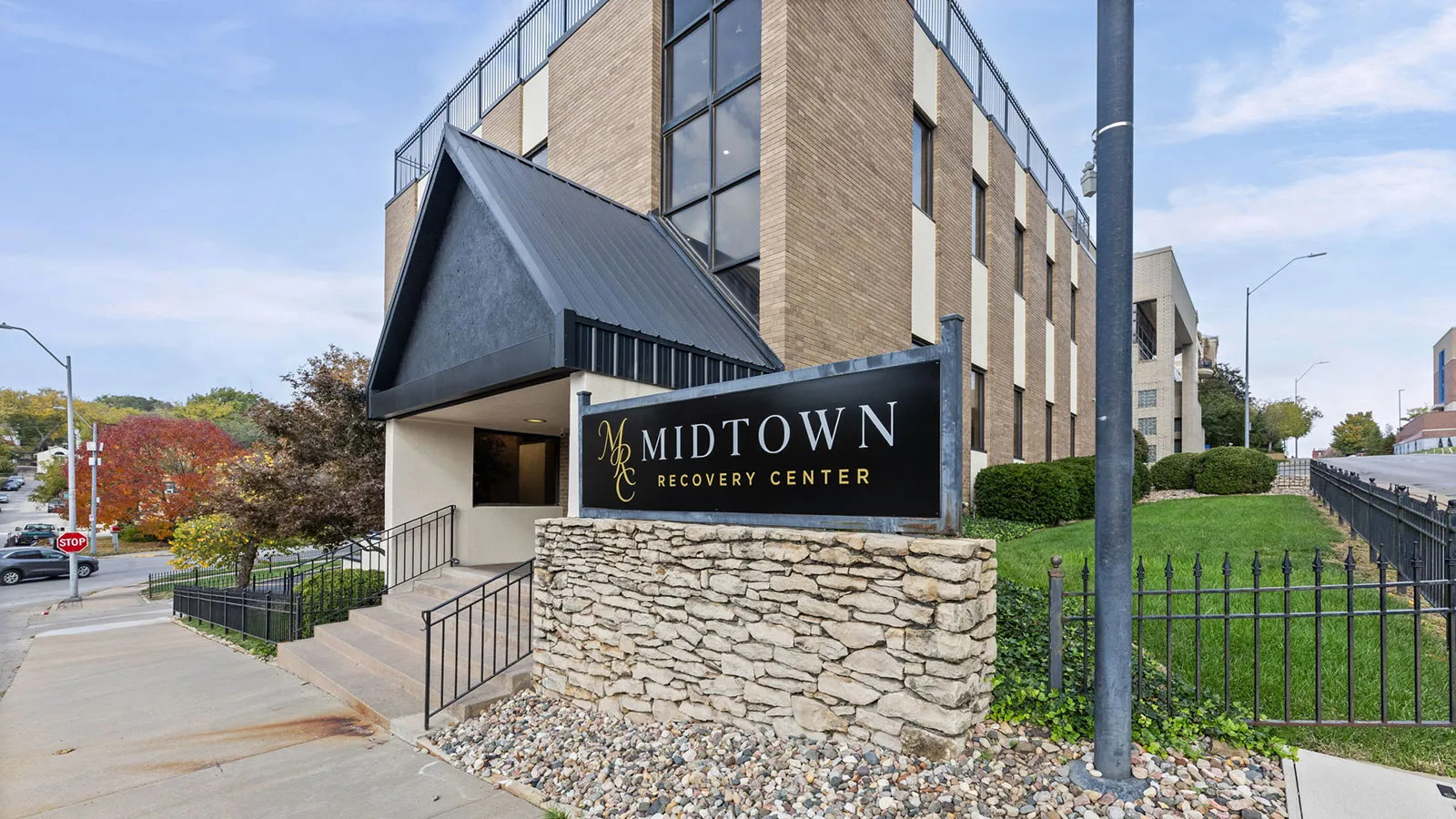
Midtown is a two-story standalone building at 1000 W 46th Street in Kansas City, Missouri. Inside, you’ll find three group rooms, private offices, and a client lounge. Because every program here is outpatient, you come in for sessions and go home afterward.
Daily life and amenities
Because every program at Midtown is outpatient, daily life stays yours. You come in for your scheduled block, whether that’s a full PHP day, a three-hour IOP session, or an outpatient appointment, and the rest of the day is for work, family, and practicing what you learned.
While you’re here, the day moves between group rooms and private offices. The client lounge is yours between sessions for a coffee, a quiet moment, or a conversation with someone who understands. You don’t need to bring much; your admissions coordinator goes over the short list before your first day.
Privacy and discretion
Privacy matters when you’re seeking substance use treatment, and the law is on your side. Federal confidentiality rules for addiction treatment (42 CFR Part 2) and HIPAA protect your records and go further than ordinary medical privacy.
In practice, that means staff will not confirm to a caller that you are a client, or share anything about your care, unless you have signed a release naming that person. You decide who is in the loop, and you can change that at any time. Your employer only learns what you choose to tell them.
Getting here

Midtown is in Midtown Kansas City near Westport and the Country Club Plaza, on the western edge of Missouri. From Jackson County and the eastern suburbs it’s a short drive; from St. Louis, Springfield, or Columbia, plan on a road trip and a place to stay. Use the map on this page to see exactly where we are, and call admissions any time if you’d like help finding us.
Directions and map
From most of Missouri, I-70 brings you into Kansas City from the east and I-49 or US-71 from the south. From there, US-71 (Bruce R. Watkins Drive) north or Southwest Trafficway takes you toward Westport and 46th Street. The building is a two-story standalone at 1000 W 46th Street in Kansas City, Missouri, a few blocks west of Main Street. Enter the address into your maps app for turn-by-turn directions.
Coming from out of area
Clients come to Midtown from across Missouri, not just the Kansas City metro. Because every program here is outpatient, you need somewhere to stay during treatment. If you’re coming from further away and don’t have a safe, substance-free place in the Kansas City area, tell admissions. We have relationships with local sober living homes and can help you think through options before you start.
Your commercial insurance works the same anywhere in Missouri, though plan rules vary. We verify your benefits before you commit.
Therapies offered here

Our therapy staff is credentialed in cognitive behavioral therapy (CBT), dialectical behavior therapy (DBT), and eye movement desensitization and reprocessing (EMDR). Your treatment plan combines the approaches that fit your needs and level of care.
For family
If your parent, sibling, or spouse is struggling with drugs or alcohol, it’s time to talk to them about getting help. Tell them about the behaviors that worry you, using specific examples instead of judgment or accusations.
Getting a loved one here
Let them know you want to help them get better and that structured treatment is the way to do it. You can look at treatment options together, offer to make the call with them, or drive them to their first appointment.
Family programming
If you want to be more involved in their recovery, family sessions are part of the program and can be held up to once a week.
Aftercare and Relapse Prevention

At Midtown Recovery Center, we understand that aftercare is as necessary as any part of the treatment process. Continued care helps prevent relapses and prepare for a life free of drug use.
Our aftercare support includes an alumni group, family group, and partnerships with local sober living homes.
Addiction in Missouri
While the U.S. addiction crisis has had recent historic drops (with overdose deaths down by 27% in 2024 compared to 2023), efforts must remain consistent to bring the numbers lower.
Missouri is a state where alcohol and drug addiction is still prevalent. A Missouri Department of Health report shows that drug overdose is the leading cause of death among adults aged 18–44 in the state.
It’s been found that overdose death rates in the past few years are particularly high near major metro areas, such as St. Louis and Kansas City.
Behind every one of those numbers is a person and a family. Getting help early, close to home, is part of turning them around.
FAQs
What are the types of drug addiction (substance use disorder)?+−
Substance use disorders are grouped by the substance involved. Common types include alcohol use disorder, opioid use disorder (OUD), cannabis use disorder, stimulant use disorder, nicotine use disorder, prescription drug use disorder, and hallucinogen use disorder. When someone is dependent on more than one substance, it's called polysubstance use disorder.
Can a mental health disorder coexist with a substance use disorder?+−
Yes; statistics show that 53% of people with a drug use disorder have at least one serious mental illness at the same time. A report by the National Institute on Drug Abuse (NIDA) estimates that 35% of U.S. adults (18 and older) with a mental disorder have a co-occurring substance use disorder. This condition is known as a dual diagnosis, psychiatric comorbidity, or a co-occurring disorder. The reason why such disorders are prevalent is that SUDs and mental illnesses stem from overlapping risk factors. Brain chemistry, genetics, chronic stress, and trauma are a few examples. Ultimately, having a mental health condition is a risk factor for SUD, and vice versa.
Can the treatment of a co-occurring mental disorder be part of an addiction treatment program?+−
Yes. For the treatment of addiction to be thorough, healthcare professionals must screen patients for any underlying mental conditions. If this aspect of recovery goes unnoticed and untreated, drug relapse will be more likely to happen because the root of the problem hasn’t been addressed. Midtown treats co-occurring mental health conditions alongside substance use disorders. Treatment can combine evidence-based therapies, like cognitive behavioral therapy (CBT), with medication when it’s clinically appropriate.
We Accept Most Major Insurance Plans
Don't let cost be a barrier to recovery. Most treatment is covered by insurance.
Our Team
Medical Director
MD
Clinical Director
LCSW
Admissions Coordinator
Accredited & Licensed
Visit Us in Kansas City
1000 West 46th Street
Kansas City, MO 64112